_Futurization
Author: Tobias Bowald, Mobility Expert at WAVESTONE
As digitally activated, modular, and climate-friendly mobility services are gaining increasing momentum in the 20-35 demographic. They are also finding their way into the workplace commute. Companies are well advised to leverage these types of services as easy as possible to continue to attract talent in the future.
How does Gen Z feel about it?
What does mobility mean for you?
64%
Flexibility
58%
Independence
54%
Freedom
Mobility budgets: more attractive, cleaner, and more cost-efficient
After all, younger generations are placing greater emphasis on flexible mobility options tailored around their needs. Accordingly, offering personal company cars as an employee perk is no longer the only way. They are being replaced by new mobility solutions and digitally managed mobility budgets for employees – which themselves are but one element in a broader sustainability management approach to corporate mobility. This gives companies a three-pronged approach to sharpening their profile: they become more attractive as an employer, transform their business model towards more sustainability, and lower their costs.
What makes corporate mobility budgets so attractive?
Freedom of choice is the key here. Employees can choose how to spend the monthly budget allocated to them to meet their mobility needs by combining the increasingly varied transport options available through traditional and innovative mobility services provided by companies and municipalities. Because, young people are increasingly reluctant to spend an hour behind the wheel to get to work, It is becoming common for young people to want seamless door-to-door mobility. This could be someone stepping out of their door, use a QR code to activate the nearest electric scooter of a shared mobility provider, drive down to the subway station, take the train for five stops, and hop on a shared electric bike for the remaining half mile to their employer. This is the epitome of true sustainability, flexibility, and user-centricity.
13% of all large enterprises in Europe have already implemented mobility budgets and almost 30% are planning to do so.
How do employees feel about spending their mobility budget?

“It’s great, I get from door to desk in just 15 minutes, never have to worry about parking, get to soak in fresh air, burn off calories, help the climate, and, as a bonus, I can even use my employer’s app on the weekends to take the train to see my friends and parents. Any portion of the budget I don’t use goes straight towards my retirement plan. It’s an attractive offer that just makes me want to recommend my employer.”
And what’s in it for employers?

“With the introduction of our mobility app “FreeToMove”, we were able to eliminate 130 company cars and with them 800 tons of CO2 CO2 per year. It has turned into a genuine sustainability project that also appeals to our investors and other stakeholders. On top of that, it saved us a net 200,000 euros in operating costs last year alone. Even better, we get to enjoy tax benefits for giving our younger employees what they now prefer in terms of mobility.”
Mobility budgets can only be truly appealing as part of enterprise-wide integrated mobility management
Employee perks like mobility budgets should not be an isolated element within the corporate strategy. To be credible, they need to fit in with an integrated sustainability plan for corporate mobility management that incorporates a variety of measures. That is the only way for companies to sharpen their overall sustainability profile with employees, customers, and investors.
Because they know: this company is systematically and continuously scrutinizing its business model to uncover opportunities to become more climate-friendly and operate in a way that contributes to a more sustainable society. And that is the path to the future. In addition to sustainability aspects, the main drivers for companies moving towards innovative mobility management are reducing costs and improving the employer brand.
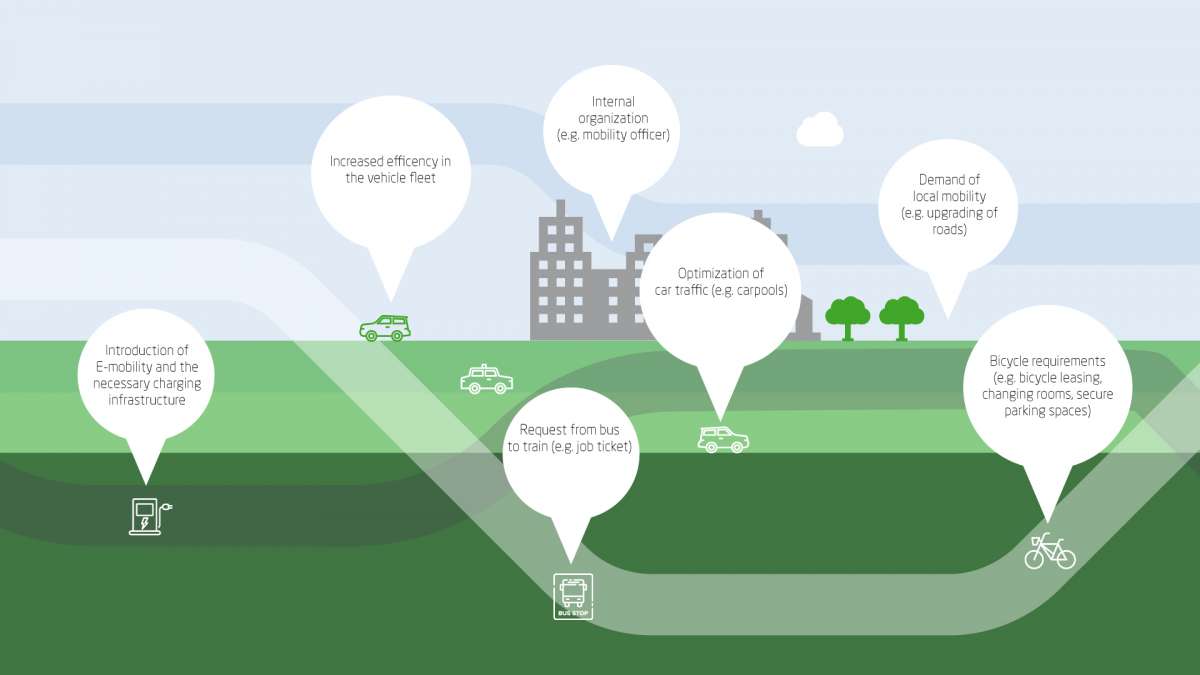
Sustainable integrated mobility management
Fig. 1: What sustainably integrated corporate mobility management could look like
Every company is different, so there is no ONE blueprint for implementing a successful mobility management approach. The following measures, however, will appeal to many companies. These are individual elements that need to be coordinated into a coherent strategy.
Corporate mobility management: a strategic factor for leading companies into the future
Companies that embrace modern and digitally-driven mobility management – for example by implementing flexible mobility budgets and mobility apps – add an attractive employee perk, save CO2 emissions, and reduce expenditure. However, such measures will only achieve their full effect towards an overall corporate mobility strategy geared toward a sustainable future if they are weaved into an integrated mobility approach with in-house services, infrastructures, and management roles.
Tobias Bowald
Mobility Expert at WAVESTONE
Tobias Bowald has been working as a mobility expert in the development and innovation environment in the mobility industry for almost ten years. His main focus is on the topics of digitalization, mobility platforms, agile application development, mobility data, and sustainability in the context of mobility.