_Futurization
Dr. Isabella Geis, Mobility Expert at WAVESTONE
Other than traditional public transport services, on-demand transport can respond flexibly to changes in demand in a way that caters to individual needs. But what exactly does it mean? Find out everything you need to know about the opportunities and risks of on-demand transport and learn why it is an essential element of any strategy to create sustainable and forward-looking mobility services able to meet the growing demands of modern passengers.

On-demand transport secures mobility in rural areas
On-demand transports ensure the supply of mobility even in rural areas.
Mobility on demand: More important today than ever
In today’s digitally transformed and connected world, we are also seeing growing mobility demands and expectations from passengers. The rigid and inflexible nature of public transport makes it increasingly difficult to meet them.
Particularly in peripheral areas and at off-peak times, public transport often reaches its limits – there simply is not enough demand to provide suitable services. But when conventional mass transit cannot respond flexibly to demand, many people will opt for their car instead.
“Public and private mobility providers will have to transform to meet the growing expectations of modern passengers, today and in the future.”
Dr. Isabella Geis, Manager Travel, Transport & Logistics
At the same time, issues like sustainability and digital transformation are gaining in importance – not to forget the new requirements that the COVID pandemic places on mobility providers and public transport operators in particular. It was proof that demand can be highly volatile. Fearing infection, many passengers had abandoned public transport altogether. Going forward, offering a flexible, safe and clean mobility experience will be the key to attracting customers.
One thing is becoming increasingly clear: Society is transforming and mobility is no exception. Mobility providers looking to face the future head one need to transform as well and create new digital services that cater to the many needs of modern passengers.
The solution: Mobility in the form of on-demand transport options that leverage state-of-the-art technology and can be flexibly deployed to meet varied demands.
What is on-demand transport?
On-demand transport refers to mobility on request offerings that are demand-responsive according to passenger needs. They usually rely on minibuses or cars to provide flexible shuttle services without fixed routes or timetabled journeys. It is the passengers who decide where they want to go and when.
In the past, these on-demand offerings were commonly known as dial-a-ride. Today, on-demand transport has gone digital: Passengers use an app to request the on-demand vehicle that will take them to their destination without having to switch rides.
The concept of having more passengers going in the same direction get on the same vehicle along the way is known as ‘ride pooling’. This smart pooling of similar ride requests is done in the background using algorithms. They find the best way to combine all requests so that passengers can share a ride without detours.
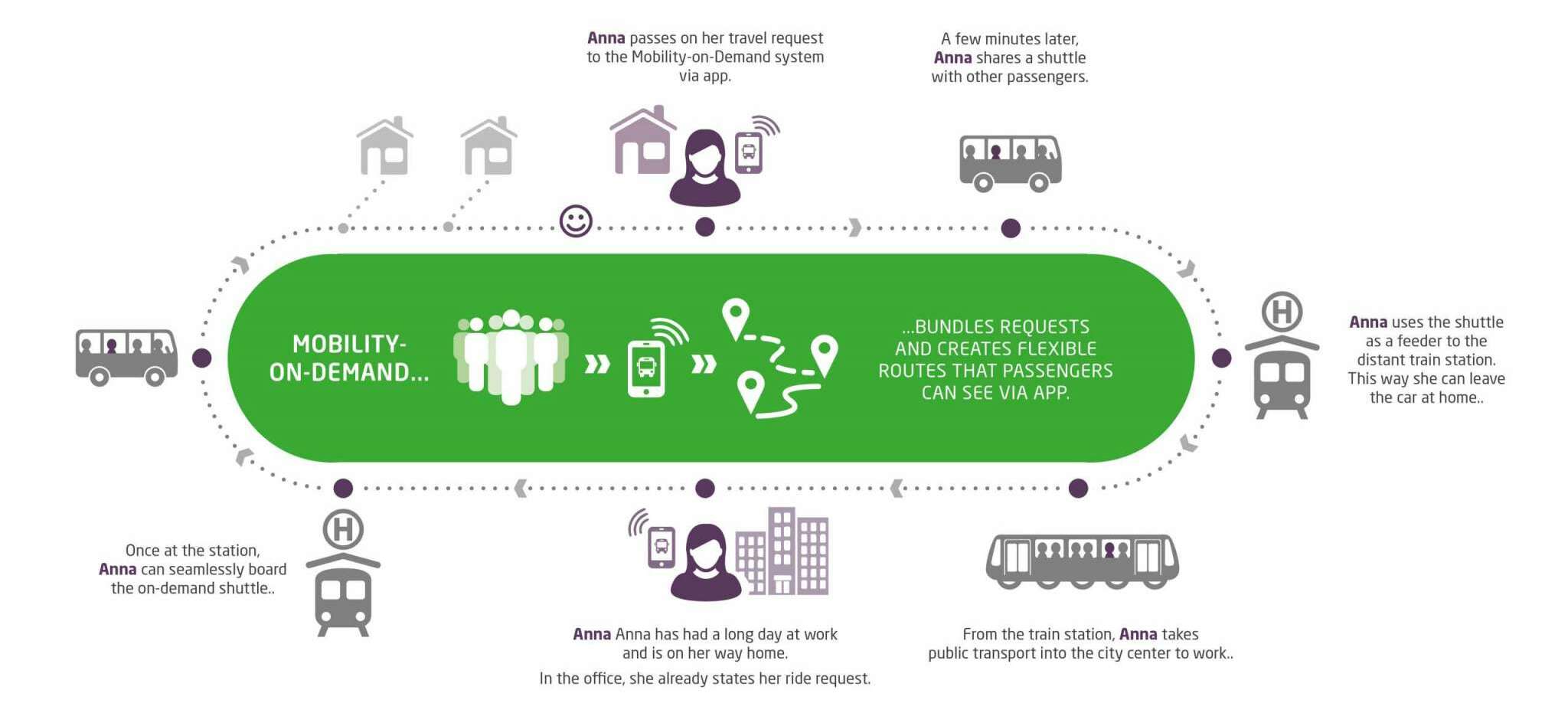
On-demand transport and personnel transport – an integrated offer
Integrated offer of on-demand transport and local passenger transport
The big advantage: By having algorithms calculate the best route, the vehicles will always travel flexibly and with utmost efficiency. They will not take the shortest route, but rather the best possible route from an overall demand perspective.
Where does on-demand transport make sense?
There are several areas where “at-a-click” on-demand transport can be a viable and flexible addition to public transport:
On-demand transport options: Differences
On-demand transport can be privately or publicly operated. Hybrid models are also an option. Then there is the distinction between:
On-demand transport: Opportunities & risks
There is no telling yet which on-demand transport option will come out on top eventually. After all, most offerings are geographically restricted or have only been around for a short time. One thing is already obvious though: On-demand transport comes with some risks, but also with many opportunities.

Mobility-on-demand – easy planning via apps
Via apps, mobility-on-demand works in no time and without much planning effort.
Risks
Long-term studies in the USA have shown that non-integrated offerings could pose competition to public transport options: Fewer people use public buses and trains, while car use remains high. This is rather unfortunate from a mobility transformation standpoint – after all, the main goal of on-demand transport is to cut back on the privileges of private car use. It needs to be pointed out though that study results such as these have little relevance to the situation elsewhere – only time will eventually point the way.
There is one takeaway though: In order for digital on-demand services to become a viable addition to public transport and a true alternative to car use they need to be tightly integrated and, ideally, become a part of existing financing systems. This is one of the biggest challenges to implementing on-demand solutions.
Opportunities
Once we have overcome this challenge, on-demand urban transport can become a flexible complement to public transport that responds to individual needs and takes a load of the infrastructure. By serving passengers’ transport needs directly while offering a real alternative to private car use. At off-peak times, such as at night or on weekends, the service provides a safe and convenient experience. However, small towns and municipalities in rural areas can also benefit as they can rely on-demand transport to ensure that their citizens have access to public mobility.
On-demand transport is also beneficial from a COVID-19 perspective: Mobility providers have implemented comprehensive hygiene rules and cashless payment options to ensure high safety and cleanliness standards.
380,000 on-demand vehicles could save 15 million tons of CO2 in Germany alone.
What’s more, on-demand transport options are usually barrier-free and, when electric vehicles are used, emission-free. This is particularly important with a view to the future of mobility as society is making great strides in areas like sustainability and inclusion. On-demand transport has the potential for transport providers to have a major impact on the transformation of mobility.
According to a Fall 2021 study by ioki 380,000 on-demand vehicles could replace all 12 million second and third cars in Germany. This would save a full 15 million tons of CO2, which is about 10 percent of annual road traffic emissions.
On-demand transport in Germany: 3 real-world examples
There are many on-demand transport success stories to be found throughout Germany – and the trend is only gaining momentum. The majority of existing mobility-on-demand solutions are integrated with public transport offerings, rely on electromobility, and use digital apps. Three examples:
LahnStar: In November 2021, the city of Limburg introduced the emission-free LahnStar-Shuttle as part of its public transport service, replacing the region’s dial-a-ride service. Using the accompanying app, passengers can request a ride to their destination in one of the city’s new small electric buses. The LahnStar is one of the sub-projects of the “On-Demand FrankfurtRheinMain” initiative launched by the region’s transport authority in collaboration with ioki for more flexible, sustainable mobility.
LOOPmünster: The western Germany city of Münster launched a digital dial-a-bus service in the Fall of 2020 as part on an integrated model. In several parts of the city, hybrid, low-emission minibuses are available as a “local transport on demand” option. Passengers can request a ride at the regular public transport fare and specify their pickup and drop-off locations using an app.
On-demand shuttle providers: More examples come from the services offered by private on-demand providers like CleverShuttle, ViaVan, and MOIA. The companies aim to offer passengers a viable alternative to urban car use with their on-demand shuttles in an effort to reduce CO2 emissions and make flexible mobility convenient and affordable.
Similar services can now be found in larger cities throughout Germany, such as Berlin with the BerlKönig, Hamburg with ioki, Cologne with ISI or Mannheim with fips.
Take an active role in shaping the future of mobility
New and innovative services like on-demand transport are the key to meeting growing mobility demands – because everyone has different needs when it comes to modern mobility and depending on their specific situation. In order to create attractive and environmentally friendly services and remain competitive in the future, mobility providers, as well as cities and municipalities, must adapt to these new realities. Smart on-demand offerings are one way to better serve new demands.
Do you want to take an active role in shaping the future of mobility? Establishing an innovative on-demand transport service in your area is nothing short of a challenge. That is because mobility only works as an overarching concept that is embedded into municipal strategies, takes regional specifics into account, and involves all relevant stakeholders in the region: municipalities, transport providers, but also city utilities, cab companies, and not to forget the citizens who will ultimately use the service.
If you are willing to meet this challenge head-on, however, there is much to gain and great progress to be made towards shaping a mobility of the future that is sustainable and meets modern needs.
We at WAVESTONE would be happy to apply our years of experience towards your success in taking this step. We will guide you at every step of implementing a mobility service that is right for you. Contact us for a free and non-binding initial consultation and we will be happy to talk about your options.
Dr. Isabella Geis
Mobility Expert at WAVESTONE
Dr. Isabella Geis is responsible for mobility at WAVESTONE. She has been a convinced mobility developer and innovator as well as a competent key note speaker in this field for many years. Previously, she was responsible for setting up the mobility division of the Center for Logistics and Mobility at Fraunhofer IML and completed her doctorate on smart mobility at Zeppelin University in Friedrichshafen. She advises municipalities, companies and public organizations on mobility innovations, data and concepts as well as on transformation processes.